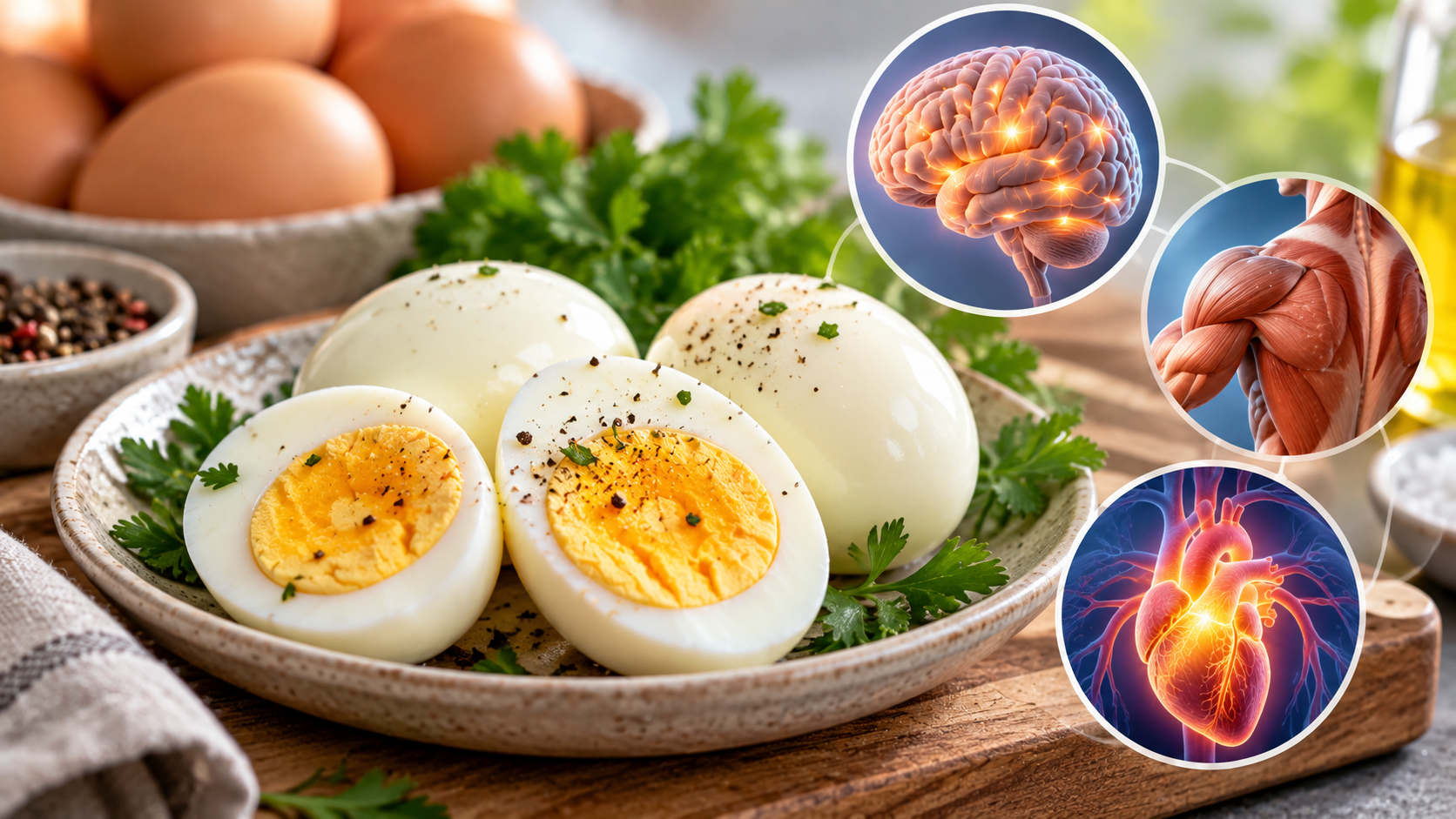
What Are Boiled Eggs?
Boiled eggs are cooked by submerging them in boiling water. Soft-boiled eggs are cooked only till the white is cooked but the yolk is still runny. Hard-boiled eggs are cooked longer, until both the white and yolk are completely cooked.
Boiled Egg Benefits
They're delightful, filling, and beneficial to your health at any age. Along with milk, eggs have the highest biological value (or "gold standard") for protein. One egg has around 77 calories, 6 grams of high-quality protein, 5 grams of fat, and 1.6 grams of saturated fat, as well as iron, vitamins, minerals, and carotenoids.
The egg is also rich in disease-fighting compounds like lutein and zeaxanthin. These carotenoids may lessen the risk of age-related macular degeneration, which is the major cause of blindness in older persons.
Here are some other examples of the health advantages of boiling eggs.
Weight loss.
Hard-boiled eggs are a great source of lean protein. They'll fill you up without adding too many calories, which is ideal if you want to reduce weight.
Prenatal bone strength.
Hard-boiled eggs include protein, which, coupled with vitamin D, promotes fetal development. These nutrients help your baby's teeth, bones, and overall growth throughout pregnancy.
A nutritious snack
Boiled eggs are compact, nutrient-dense food packages. One large, hard-boiled egg offers your body with numerous nutrients, including:
6.3 grams of protein—adults should consume 50-175 grams of protein daily.
25 milligrams of calcium—adults should consume 1,000-1,200 mg per day.
0.595 milligrams of iron -- individuals should consume approximately 8-18 milligrams per day.
63 milligrams of potassium -- individuals should consume approximately 2,600-3,400 mg each day.
Source of Choline
Choline is essential for cellular upkeep and growth, and hard-boiled eggs are the most abundant source of it in the American diet. Choline may improve brain growth and memory.
Eye protection
Lutein and zeaxanthin, which are contained in boiled eggs, have antioxidant and anti-inflammatory characteristics that promote eye health.
Increased mental energy
The mix of nutritious nutrients in hard-boiled eggs, such as protein and choline, helps to wake up your brain, especially just after breakfast.
Boiled Egg Nutrition
Boiled egg nutrition per serving
A single big hard-boiled egg (one serving) contains:
Calories: 77.
Total fat: 5.3 g.
Saturated fat: 1.6g
Cholesterol: 186 mg.
Sodium: 62 mg.
Carbohydrate: 0.56 grams
Sugar: 0.56 grams.
Protein: 6.3 g.
Hard-boiled eggs include vitamins A and D.
Things to look out for
Eggs, regardless of how they are prepared, contain saturated fats and can elevate LDL, or "bad," cholesterol levels, albeit not as much as other foods. Food preparation also affects how healthy your eggs are. For example, many people season their hard-boiled eggs with salt. This will increase the quantity of sodium you consume. Other ways to prepare eggs can have an impact on their nutritional value. For example, frying eggs adds saturated fat. Boiling eggs preserves the majority of their nutritional value.
In terms of preparation, the only distinction between soft-boiled and hard-boiled eggs is how long they are cooked. Boiled eggs have lots of nutrients regardless of how long they are cooked, but harder-boiled eggs are a better option for avoiding hazardous pathogens like salmonella.
How To Make Boiled Eggs
Preparing boiled eggs is quite simple, though some people struggle to strike the perfect balance between cooking time and desired yolk hardness. It may take some trial and error before you reach your timing sweet spot.
How long does it take boiled eggs to cook?
Place the egg and its shell in boiling water until the inside is fully cooked. The longer you keep it in the water, the more thoroughly cooked the egg will be. Hard-boiling an egg takes roughly 10-12 minutes.
Hard-boiled eggs in the microwave.
If you like to hard boil your eggs in the microwave, here's how. Keep in mind that microwaves have varying settings and strengths, so you may need to experiment to find the optimum timing.
Spray or wipe a little quantity of frying oil into a small, microwave-safe container, such as an egg cooker, ramekin, or mug. Sprinkle a few grains of salt on the bottom.
Crack open an egg and transfer the contents to the container. It is critical to use a fork to poke the yolks and whites (four or five times), or the egg will rupture while in the microwave.
Cover the container with plastic wrap, but pull it slightly apart to let air to escape during the cooking period.
Set your microwave to high and cook for 40 seconds. Do not remove the cover for another 30 seconds.
If the egg is not cooked to your pleasure, flip it over in the container and microwave for additional 10 seconds at a time until done.
Air-fryer cooked eggs
As air fryers grow increasingly popular, you might want to try this method for making hard-boiled eggs.
Start by heating your air fryer to 250 degrees Fahrenheit.
Then, insert your egg(s) in the air fryer basket and cook them. Set the timer for fifteen minutes.
When finished, place the eggs in cold water for around 8-10 minutes to cool off.
Steam-boiled eggs
Steam-boiling is similar to boiling eggs, except that steam is used to cook them.
You'll need a steamer insert that fits in your pot. Fill your saucepan with water until it is just below the bottom of the steamer, ensuring that the eggs do not come into contact with the water.
Heat the water just before it boils.
Add your egg(s) to the steamer basket, cover the pot, and let the water simmer for 15 minutes.
Place the eggs in a very cold or ice water bath for approximately 20 minutes.
Hard-boiled eggs made in the Instant Pot
If you have an Instant Pot or equivalent pressure cooker, you can boil your eggs in the following way:
Pour 1 cup of water into the bottom of the pot.
Place a steamer basket or trivet (anything to keep the eggs out of the water) in the pot. Place the eggs on the basket or trivet and seal the pot, making sure the pressure release valve is closed.
Select the manual feature and set it to 5 minutes.
Release the steam and place the eggs in cold water to cool.
Boiled Egg Storage
Boiled eggs are a convenient snack or dinner element that may be made ahead of time. However, eggs can dry up or develop bacteria and viruses on the shells, which can be transferred to the inside when peeled. So it's critical to keep the eggs properly.
Many people boil eggs before dyeing them for Easter celebrations and egg hunts, thus storage safety is important to consider. The FDA advises against eating hard-boiled Easter eggs that have been concealed or played with, as they may contain bacteria and viruses.
How long can hard-boiled eggs last in the refrigerator?
Hard-boiled eggs can be refrigerated for up to a week.
How long do unpeeled hard-boiled eggs last without being refrigerated?
Hard-boiled eggs should be consumed right away or refrigerated for later. Unpeeled hard-boiled eggs should not be left out of the refrigerator for more than 2 hours. This is another reason why buried Easter eggs should not be consumed.
How long does a soft-boiled egg last?
Unpeeled soft-boiled eggs can be stored in the refrigerator for up to two days.
Can you freeze boiled eggs?
It is not suggested to freeze hard-boiled eggs, but you can separate and freeze the cooked yolk. Technically, you could freeze the whites, but they normally become harsh and watery after freezing.
How to Peel Boiled Eggs.
Some folks have a favored method for peeling a boiled egg. Here's one approach that frequently yields positive results:
Crack the egg carefully on the counter, twisting it so that cracks appear all over.
Pick up the egg and hold it upright. Roll it between your hands many times. This will loosen the shell.
Peel the egg from the bigger end first. If the peel is difficult to remove, try running the egg under cold water or immersing it in a dish of cold water.
Concluding
Boiled eggs make an excellent, healthful snack or breakfast item. They are simple to cook and can be made in a variety of ways, including boiling in hot water, air frying, and pressure cooking. Boiled eggs are particularly handy to have because they can be kept in the fridge for up to a week.