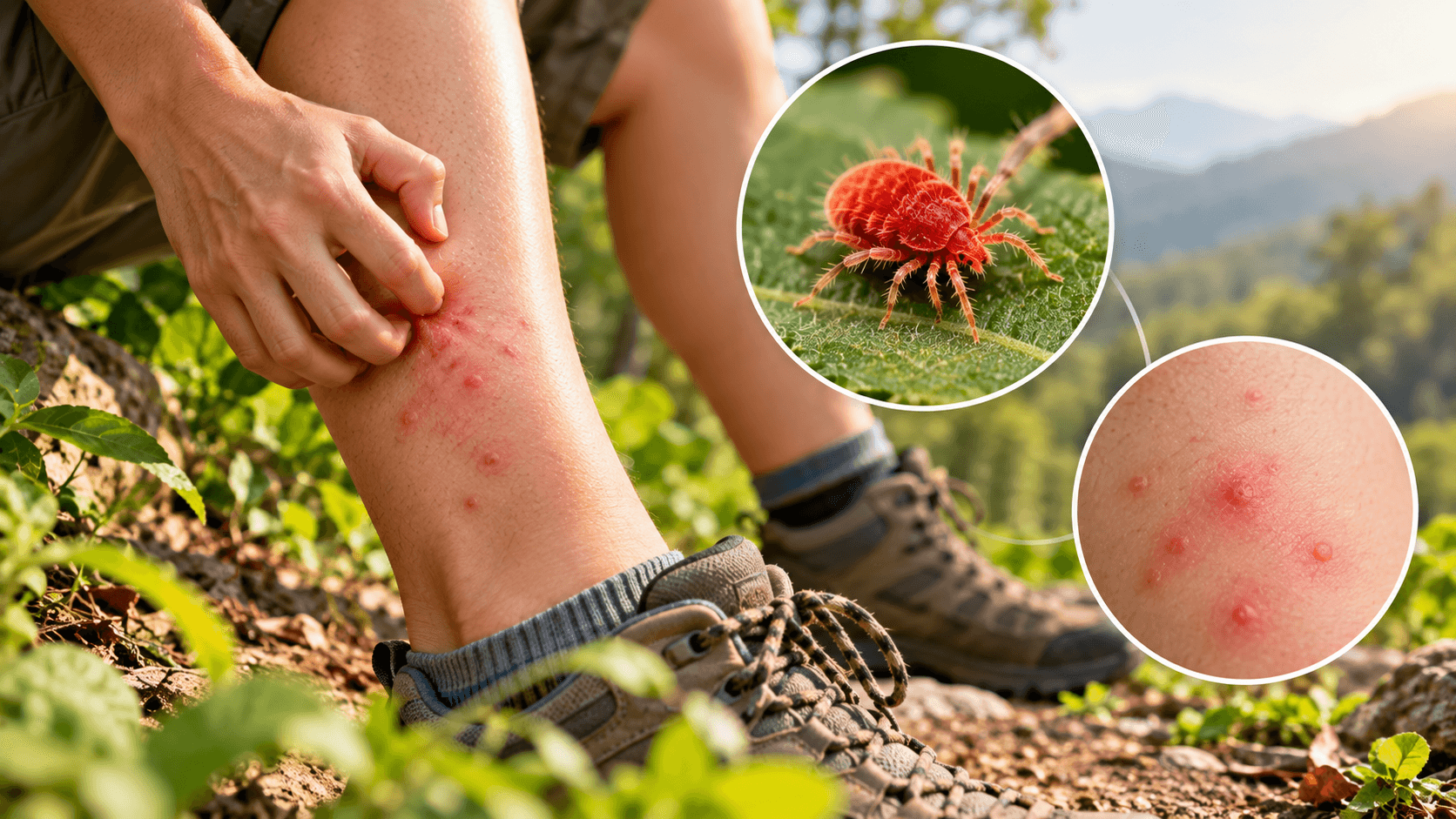
What are chiggers?
Chiggers are tiny insects that can only be seen with a magnifying glass. Scientists refer to these critters as "trombiculid mites" since they belong to the Neotrombicula autumnalis mite family. But they have a lot of nicknames. In North America, they are commonly known as chiggers. In the United Kingdom, they are known as harvest mites. They are also known as berry bugs, bush mites, red bugs, or scrub-itch mites.
Chiggers are actually not insects. They are classified as "arachnids," which is the same family as spiders and ticks. While chiggers do not pose a significant threat to your health, their bites can cause you to itch excessively.
Adult chiggers do not bite. You need to keep an eye out for the babies, known as larvae.
How do chiggers look like?
If you like creepy crawlies, you might think chiggers are really cool. If not, a close-up of a chigger may evoke images from a horror film.
Chiggers are only 0.3 millimeters long, but as you zoom in, you can tell they are hairy and red. (They turn yellow when they're full.) Adult chiggers have eight legs, but the immature ones that bite you only have six. While chiggers have mouth parts that can pierce your skin, their pinchers are short and weak. This is why chiggers bite soft, foldable, or wrinkled skin.
Where do chiggers live?
You can traverse the world, but you cannot avoid these pests. Chiggers exist in every country. Their preferred habitats are damp, grassy regions such as fields, woodlands, and even your yard. They can also be found around lakes and streams.
After hatching from eggs, newborn chiggers cannot fly very far. They typically remain clumped together in big bunches on leaves and grass, less than a foot off the ground, and attach to passing animals or people.
In the United States, chigger bites are most common in late spring, summer, and early fall. The bugs are active when the ground temperature ranges between 77 and 86 degrees Fahrenheit, and they cannot live if the temperature drops below 42 degrees.
What are Chigger Bites?
Chiggers grip onto your jeans or shirt and crawl about until they find a spot of skin. After making microscopic holes in your skin, they inject saliva (spit), which converts some of your cells to mush.
Why do they do this? To a chigger, those now-liquid cells represent food. A chigger may stay stuck to your skin for several days as it feasts.
Do chiggers burrow beneath your skin? You've probably heard this before, but it's simply not true. Chiggers have weakened mouth muscles. They can grab onto you but not go any deeper. This myth most likely originated because, as a chigger bite turns red and bulges, it can begin to surround the chigger itself.
What does a chigger bite look like?
You may notice a line of little red dots or what appear to be pimples - elevated red bumps or pustules. Chigger bites can occur anywhere on your body, although they typically appear in clusters around your waist or lower legs.
Symptoms of Chigger Bite
The most obvious indicator that you've been bitten by a chigger is itching. A few hours after being bitten, you will have a strong need to scratch.
The itching typically lasts many days and can keep you awake at nite. Aside from little red bumps, your skin may develop blisters or a hive-like rash that can take a week or two to recover.
If you get a chigger bite on your penis, you may develop a condition called "summer penile syndrome." It causes swelling, irritation, and difficulty urinating. This can last for a few days or weeks.
Scratching a chigger bite may break your skin and cause inflammation or infection.
Chiggers in the United States do not transmit disease, although they do in other parts of the world. Scrub typhus is caused by Orientia tsutsugamushi bacterium, which can be transmitted by the bites of infected chiggers. It can be deadly if not treated with antibiotics.
The majority of scrub typhus cases are caused by chiggers in Southeast Asia, Indonesia, China, Japan, India, and northern Australia. Consult a doctor if you have any of the following symptoms after traveling to one of these areas:
Chigger bites with black scabs.
Skin rash
Fever
Chills
Headache
Muscle ache.
Body hurts.
Feeling puzzled.
Swollen lymph nodes.
Treatment for chigger bites
If you suspect you've been among chiggers, conduct a thorough body check. You may see little red dots moving swiftly or sticking to your skin.
The first step is to take a bath or shower and cleanse your skin with soap and water. This removes any chiggers that are still on you.
To destroy any bugs that are still lingering around, wash your clothes and any blankets or towels that have come into contact with the ground with hot water.
Then, apply an over-the-counter anti-itch cream or ointment on your bites, such as menthol, calamine lotion, or hydrocortisone. Taking antihistamines or applying a cold compress can also provide comfort.
Chiggers can be removed without the use of an anti-parasite medicine. Oral medications such as ivermectin are used to treat a distinct type of mite called scabies.
Another myth is that you may kill chiggers by applying nail paint or petroleum oil to your skin. This does not work either.
Chigger bites normally heal on their own. However, if yours are still bothering you after a few days, consult your doctor. In rare circumstances, steroid shots may be required to relieve itching and swelling. If your bites become infected, your doctor may recommend that you take antibiotics.
How To Get Rid Of Chiggers
To help prevent these annoying mites out of your yard, keep up with mowing, weeding, and brushing. In severe circumstances, some pest control methods may be effective. Look for a lawn spray that contains any of these chemicals:
Bifenthrin
Cyfluthrin
Esfenvalerate
Permethrin
To apply, follow the instructions on the label. Make sure to keep dogs out of the area until it is completely dry. Many pesticides can be hazardous to pets.
Keep in mind that these treatments will not eliminate chiggers permanently. They will probably only clear your yard for a week or two.
How to Prevent Bites
What is the best technique to avoid chigger bites? Avoid grassy or wooded regions, as they thrive there. (Especially in the summer, chiggers enjoy hot, humid weather.)
When you spend time outside where chiggers may be present, use an insect repellent containing DEET or wear clothing treated with an insecticide such as permethrin. When using bug spray, pay special attention to locations where chiggers may move from clothing to your skin, such as the waistband of your jeans and the tops of your socks.
According to certain research, natural sprays can help keep chiggers away. Consider oils derived from citronella, tea tree, jojoba, eucalyptus, geranium, or lemon grass.
Of course, don't make yourself a tempting target for a hungry chigger. Wear large sleeves and long pants, tucking the pant legs into long socks. When you go inside, take a shower to remove any chiggers that may have caught a trip.
Chiggers on pets, including dogs.
Chiggers can feed on both you and your pets. They are most likely to be found on your dog or cat's head, tummy, feet, or ears, where there is less fur. Even if you don't see the chiggers themselves, you may notice your pet scratching frequently. You may also see redness, crusty lumps, and hairless areas.
Call your veterinarian for tips on how to help your pet. If scratching has infected their skin, they may require antibiotics or other treatments.
Conclusion
Chiggers are mites that feed on your skin and live in regions with thick grass, dead leaves, or a lot of undergrowth. While their bite can cause redness, lumps, blisters, and intense itching, chiggers in the United States can not transmit illness. If you've been bitten by chiggers, wash the affected area or take a shower right away. Over-the-counter anti-itch lotions are usually sufficient to soothe your skin.
If your skin worsens, contact your doctor. You may have an infection that requires treatment.