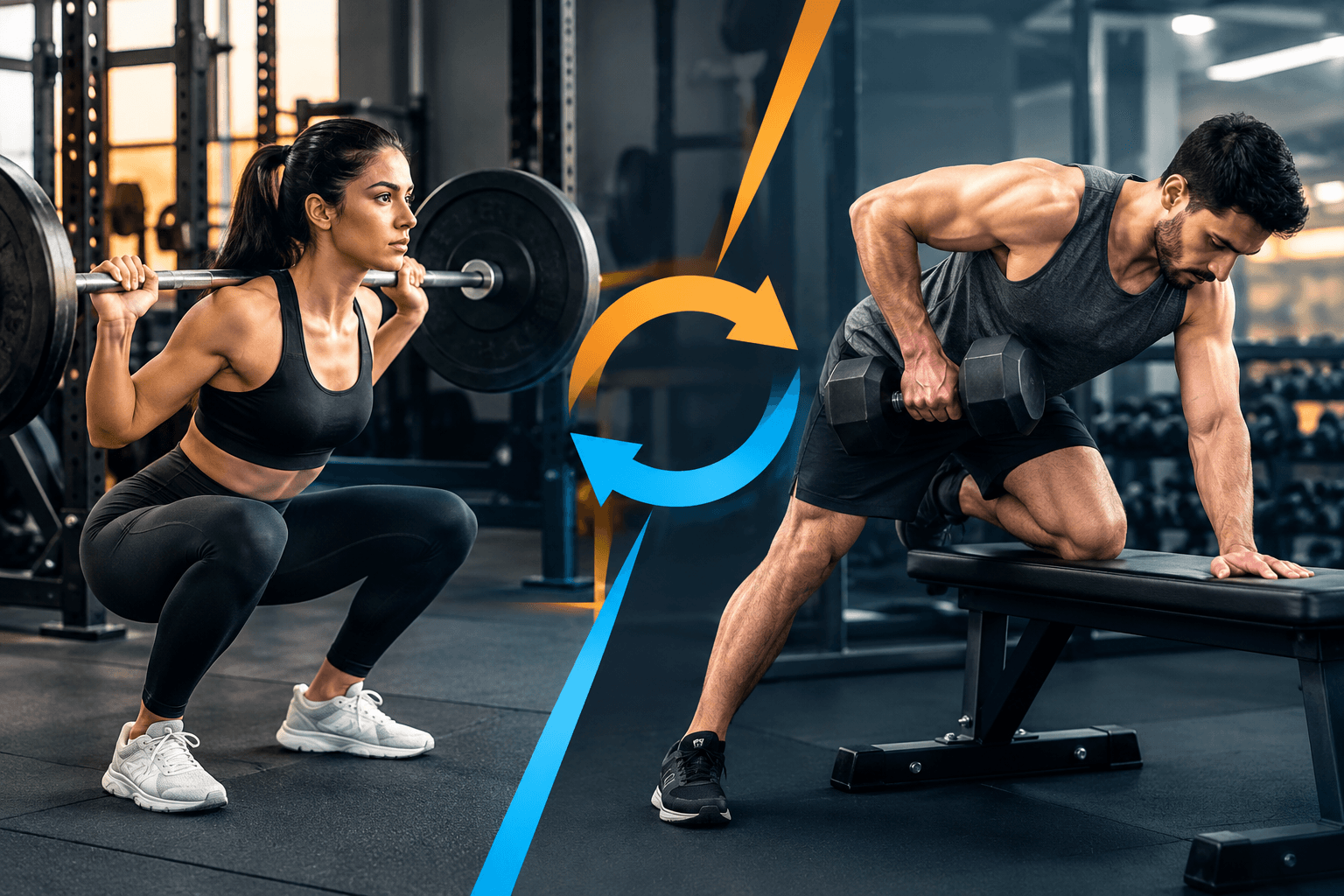
When it comes to increasing fitness gains from your workout routine, you have numerous programming options to make the most of your time at the gym.
In this context, you've probably heard of supersets in weight training.
This article explains everything you need to know about supersets, including what they are, how to use them, and the pros and drawbacks of this programming technique.
What is a superset?
Traditional resistance-training programming requires you to complete all prescribed sets of the first exercise before progressing to the second exercise.
With supersets, you execute the first set of the second exercise immediately after finishing the first set of the first exercise, but before starting the second set of the first exercise.
The overall number of sets is often the same for both approaches; however, the length of rest is reduced because the sets are performed back-to-back rather than taking the customary rest between weightlifting sets.
As a result of the short rest interval, the overall workout time is reduced while the aerobic intensity increases.
Types of Supersets
Depending on your goals, you can use one of several different types of supersets.
Push-pull supersets.
Push-pull supersets entail doing two workouts with opposing muscle groups.
Examples include:
Bench press, followed by barbell rows
Quadricep extension, followed by hamstring curls.
barbell overhead press, followed by pullups.
Push-pull supersets are excellent for shortening your overall workout duration while doing resistance training for muscular building.
Because you're employing opposing muscle groups, your strength on the second exercise will be less lost than on the first, even with a short rest period.
By the time you begin your second set, the muscles utilized in the first exercise should have recovered sufficiently between your rest intervals and the time spent on the second exercise set.
Recent study supports the use of supersets to improve training efficiency and shorten training times. However, more rest may be required following the training session before the next training session due to the increased metabolic demand of the supersets.
Overall, push-pull supersets are the most extensively researched superset protocol.
Upper-lower supersets.
The second sort of superset involves performing an upper body exercise followed by a lower body exercise, or vise versa.
This strategy allows you to train huge muscle groups in the lower body while also working on your upper body.
Upper-lower supersets are an effective way to combine aerobic and strength training, especially when rest periods are brief.
Upper-lower supersets are also an excellent choice for completing a full-body workout in a single session.
Pre-exhaustion compound isolation sets
The third superset method is to perform an isolation exercise followed by a compound exercise that utilizes the same muscle group. For example, perform bicep curls followed by seated rows.
You can perform the isolation movement first or second. If performed first, your pre-exhausted biceps will have less output on the rows, theoretically requiring greater use of your back muscles for the row.
Performing an isolation exercise after a compound one, which is known as a post-exhaustion superset, will add an extra blast of work to that muscle, and you’ll certainly feel the burn.
However, there’s not a ton of research on the effectiveness of pre-exhaustion supersets.
Compound or cluster sets
Cluster sets are the most advanced type of superset and involve performing a high resistance compound exercise in multiple mini-sets instead of one longer set.
For example, a cluster set may include doing a mini-set of 3–4 repetitions, resting for 30 seconds, doing another mini-set followed by rest, and then repeating this pattern a third time.
When the cluster set is complete, you have completed the same volume of repetitions as you would in a traditional set. But with the added rest time, you’ll theoretically have more power. For example, instead of lifting at 75% of your one-repetition maximum (1RM), you may be lifting at 90%.
This makes cluster sets a challenging and effective way to achieve progressive overload without burning out.
Some research suggests cluster sets may help power and velocity maintenance when training for sport, as they allow you to work closer to your maximal output for more reps.
Other recent research has shown relatively little benefit from cluster sets compared with traditional programming.
As a general rule, only perform cluster sets under supervision from a qualified strength and conditioning coach.
Benefits of supersets
The primary benefit of supersets resides in the overall shortened workout time for a given number of exercises, compared with a standard resistance program in which you complete all sets of a single exercise before moving on.
Additionally, if you’re wanting to mix your resistance training with cardio exercise, you may benefit from utilizing supersets.
Research suggests that push-pull supersets generate better aerobic and metabolic responses than typical programming while simultaneously reducing overall workout duration.
Beyond the shorter duration and increased aerobic effect of supersets, evidence is generally mixed on the extra benefits of supersets.
Risks of supersets
Other than the baseline dangers of any resistance training, supersets are fairly safe overall.
The major concern of supersets is that exhaustion may make maintaining appropriate technique more difficult.
The more technically hard an exercise, the more weariness may hamper your ability to maintain good form.
To avoid this, consider selecting exercises with less technical demand when completing supersets. For example, choosing leg press over barbell back squat, or dumbbell chest press instead of barbell benching.
If you can maintain good form on your workouts while supersetting, this is less of an issue.
However, if your technique begins to go awry as the fatigue increases throughout your superset, either stop and rest, do easier exercises, or decrease the resistance.
Regardless, always consult your healthcare expert before commencing an exercise regimen.
Who shouldn’t perform supersets?
Although supersets are generally safe for most healthy people, there are a few reasons to avoid them.
Supersets are not ideal for maximal strength and power activities, with the possible exception of cluster sets that have been properly overseen by a skilled coach.
If you want to exercise maximal or near-maximal strength and power, you need prevent exhaustion.
Longer rest periods will allow you to maximize output on each cycle, resulting in higher gains in these specific aspects of performance.
As a result, you should avoid supersets while training for maximum strength and power.
Furthermore, if you're a newcomer at the gym, supersets can complicate your workout program.
It's fine if your trainer instructs you to do supersets while supervising your form.
However, acquiring good exercise technique is the first priority for beginning fitness enthusiasts, and if the tiredness and complexity of supersets limits your technique improvements, you should postpone supersets until later in your fitness journey.
What exercises are best for supersets?
Given that push-pull sets are the most extensively studied type of superset, you should concentrate any superset research on this strategy.
With that in mind, the greatest exercises for supersets are those that target distinct opposing muscle groups. Most upper body workouts are suitable for this, as they are often push or pull exercises.
You can further categorize the exercises as horizontal or vertical pushing and pulling.
For push-pull supersets, combine a horizontal push with a horizontal pull or a vertical push with a vertical pull.
Here are some examples of exercises from each.
Vertical push.
Exercises include the barbell overhead press, dumbbell overhead press, seated military press, and shoulder press machine.
Vertical Pull
Perform pullups, chinups, and lat pulldowns.
Reverse grip lat pulldowns.
Cable pulldowns
Horizontal push.
Exercises include push-ups, barbell bench press, dumbbell bench press, and sitting chest press.
TRX pushups
Horizontal Pull
Dumbbell rows.
Exercises include barbell and seated rows.
TRX rows
Isolation exercises can also be used effectively in supersets. For example:
bicep curls and tricep extensions.
Examples of exercises include chest and rear delt flyes, as well as leg extensions and curls.
calf raises and banded ankle dorsiflexion
Major compound lower body exercises are less suitable for this type of superset because they typically use similar muscle groups.
For example, squats and deadlifts both hit the quads, glutes, and hamstrings. As such, they’re not useful for opposing muscle group supersets.
For lower body exercises, consider supersetting with an unrelated upper body exercise.
For example:
back squats and pullups
deadlifts and overhead press lunges and bench press
How to program supersets into your workout
If you want to implement supersets in your workout, consider picking two or four exercises to superset within your current program.
For example, if you already do bench press and rows, try supersetting them in your next workout.
You do not have to perform supersets for every exercise in your program. Start by picking the most obvious exercises to pair in your program.
If you’re focusing on maximal improvement in a single exercise like the bench press, you could do traditional sets on the bench press and then superset your other assistance exercises, such as bicep curls and triceps extensions.
Feel free to get creative with your supersets as needed.
There’s no minimal or maximal number of supersets to include in your workout, and as you experiment, you can pick and choose where this training method best fits into your current program.
Concluding
Supersets are one of several strategies to adjust your resistance training for individual aims.
Supersets entail executing a set of one exercise immediately followed by a set of a second exercise.
The primary benefit of supersets is shortened overall training time and greater aerobic demand. However, supersets are not ideal when training for maximal strength and power in most instances.
Consider adding supersets into your current workout program for extra variety, efficiency, and cardio benefit to your resistance-training routine.